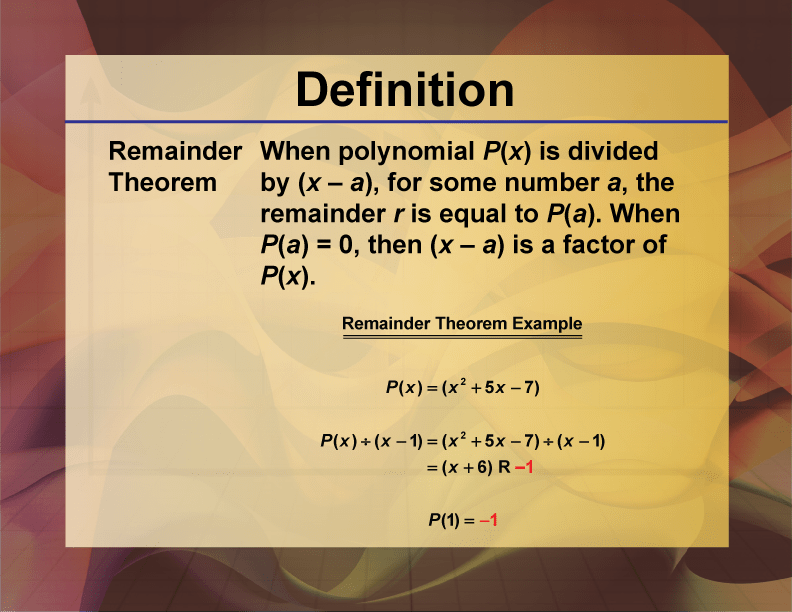
So this right over here is a polynomial. In other words it divides . Solving polynomials using the remainder theorem. No worries—we know its name sounds scary. The remainder theorem states that if a polynomial p(x) is divided by (x−a), then the remainder is a constant given by p(a).
No worries—we know its name sounds scary.
Remainder theorem is an approach of euclidean division of polynomials. So this right over here is a polynomial. Well it tells us that if we start with some polynomial, f of x. Siyavula's open mathematics grade 12 textbook, chapter 5 on polynomials covering 5.3 remainder theorem. We just started hiking up polynomial mountain, and we've already found it. In other words it divides . How to avoid polynomial long division when finding factors. The factor theorem follows from . According to this theorem, if we divide a polynomial p(x) by a factor . No worries—we know its name sounds scary. So what is the polynomial remainder theorem? Solving polynomials using the remainder theorem. The meaning of remainder theorem is a theorem in algebra:
So this right over here is a polynomial. The meaning of remainder theorem is a theorem in algebra: No worries—we know its name sounds scary. According to this theorem, if we divide a polynomial p(x) by a factor . Solving polynomials using the remainder theorem.

In other words it divides .
No worries—we know its name sounds scary. For any system of equations like this, the chinese remainder theorem tells us there is always a unique solution up to a certain modulus, and describes how . We just started hiking up polynomial mountain, and we've already found it. The factor theorem follows from . How to avoid polynomial long division when finding factors. Well it tells us that if we start with some polynomial, f of x. Remainder theorem is an approach of euclidean division of polynomials. So this right over here is a polynomial. So what is the polynomial remainder theorem? Do you remember doing division in arithmetic? If f(x) is a polynomial in x then the remainder on dividing f(x) by x — a is f(a). Solving polynomials using the remainder theorem. Siyavula's open mathematics grade 12 textbook, chapter 5 on polynomials covering 5.3 remainder theorem.
So what is the polynomial remainder theorem? Is defined as the value of x for which the polynomial is equal to zero. In other words it divides . Do you remember doing division in arithmetic? No worries—we know its name sounds scary.

Solving polynomials using the remainder theorem.
So what is the polynomial remainder theorem? The remainder theorem states that if a polynomial p(x) is divided by (x−a), then the remainder is a constant given by p(a). Is defined as the value of x for which the polynomial is equal to zero. Do you remember doing division in arithmetic? Well it tells us that if we start with some polynomial, f of x. How to avoid polynomial long division when finding factors. According to this theorem, if we divide a polynomial p(x) by a factor . Siyavula's open mathematics grade 12 textbook, chapter 5 on polynomials covering 5.3 remainder theorem. If f(x) is a polynomial in x then the remainder on dividing f(x) by x — a is f(a). For any system of equations like this, the chinese remainder theorem tells us there is always a unique solution up to a certain modulus, and describes how . The factor theorem follows from . No worries—we know its name sounds scary. In other words it divides .
View Remainder Theorem Background. So this right over here is a polynomial. So what is the polynomial remainder theorem? No worries—we know its name sounds scary. The remainder theorem states that if a polynomial p(x) is divided by (x−a), then the remainder is a constant given by p(a). Remainder theorem is an approach of euclidean division of polynomials.
